

Shopify SEO Guide — Rank on Google and Drive Organic Traffic Without an Agency
What Is the Shopify SEO Guide?
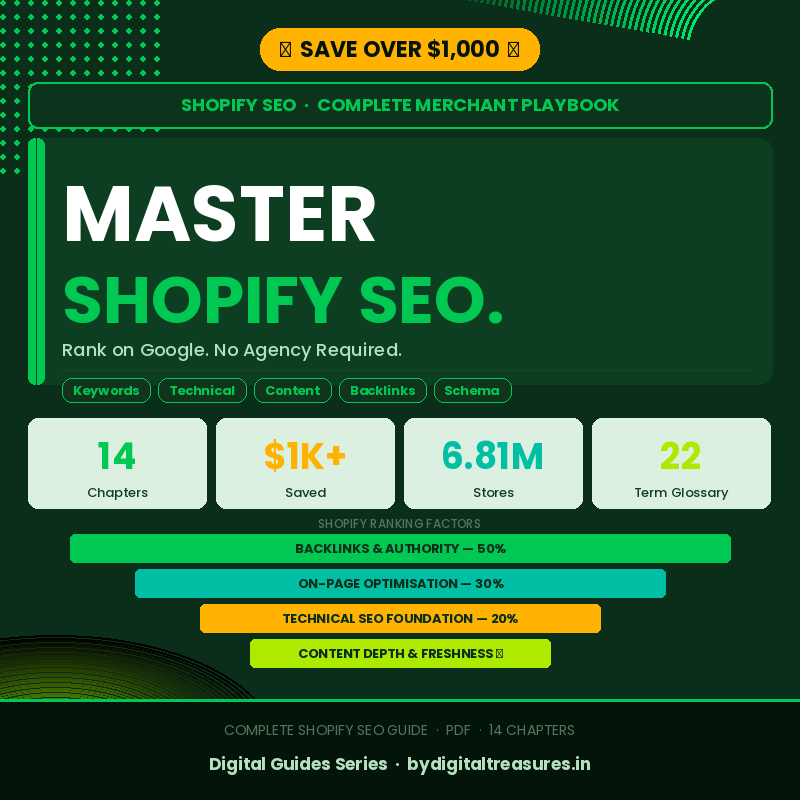
This is a 14-chapter PDF playbook that teaches you how to rank your Shopify store on Google — step by step, without prior SEO experience and without paying an agency. The guide covers the complete Shopify SEO system: keyword research by page type, product page optimisation, collection page strategy, technical SEO fixes, site architecture, schema markup, content marketing, backlink building, Core Web Vitals, and a 30/60/90-day action plan. Every chapter is grounded in 2026 Shopify-specific data and directly actionable in your Shopify admin.
A Shopify SEO audit from an agency costs $500–$2,000. Monthly SEO management retainers run $1,000–$5,000. Collection page copywriting for 10 pages costs $400–$1,500. This guide teaches you to perform every one of those services yourself — saving over $1,000 in the first 90 days. Shopify powers 6.81 million active stores worldwide, processes $378 billion in GMV, and holds 30% of the US ecommerce market. The stores that rank on Google are not doing anything mysterious — they are doing the specific things this guide teaches.
What Is Inside the Shopify SEO Guide?
The guide spans 14 chapters, seven original diagrams, a complete 30/60/90-day action plan, and a 22-term glossary covering every Shopify SEO concept you need. Each chapter is self-contained so you can jump to the specific challenge you face — or work through in sequence to build a complete SEO system from the ground up.
- Chapter 1 — Shopify and the SEO Opportunity: 6.81M Stores, $378B GMV
- Chapter 2 — What Shopify Handles vs What You Must Optimise
- Chapter 3 — Keyword Research: Finding Buyer-Intent Terms for Every Page Type
- Chapter 4 — Product Pages: The SEO Engine of Your Store
- Chapter 5 — Collection Pages: The Most Underused SEO Asset on Shopify
- Chapter 6 — Technical SEO: Fixing the Issues That Block Rankings
- Chapter 7 — Site Architecture: Structure That Search Engines Love
- Chapter 8 — Schema Markup: Earn Rich Snippets and More Clicks
- Chapter 9 — Content Marketing: The Blog That Drives Compound Traffic
- Chapter 10 — Backlink Building: The 50% of SEO Most Merchants Ignore
- Chapter 11 — Page Speed and Core Web Vitals: Google’s UX Ranking Factors
- Chapter 12 — Save $1,000+: This Guide vs Hiring a Shopify SEO Agency
- Chapter 13 — Quick-Win Action Plan: 30 / 60 / 90 Days
- Chapter 14 — Glossary of Shopify SEO Terms (22 definitions)
What Shopify Handles vs What You Must Do
Chapter 2 explains exactly where Shopify’s automatic SEO ends and your manual optimisation begins. Shopify handles SSL certificates, sitemap.xml generation, canonical tags on product and collection pages, 301 redirects when URLs change, and mobile-responsive themes. What Shopify does not handle: custom title tags, keyword-rich product descriptions, internal linking structure, schema markup quality, image alt text, and the content strategy that gives Google a reason to rank your pages. Chapter 2 includes a split diagram showing both sides of this boundary, so you know precisely where to focus your effort.
You can find related digital guides in our series at bydigitaltreasures.in — including Moz SEO, Semrush, and Ahrefs guides that complement this Shopify-specific playbook.
Collection Pages — The Most Underused SEO Asset on Shopify
Chapter 5 covers the highest-volume SEO opportunity most Shopify merchants completely ignore. Most stores treat collection pages as filtered product grids with no text — leaving high-volume category keywords unranked. A well-optimised collection page combines a keyword-rich H1, a 200–500 word introductory paragraph targeting the broad category keyword, subcollection links for internal structure, and a FAQ section at the bottom for featured snippet eligibility. Collections rank for the broadest and highest-volume terms in your niche — they are the gateway that funnels organic traffic down to individual products.
Technical SEO — The Foundation That Unlocks Rankings
Chapter 6 addresses the Shopify-specific technical issues that consistently suppress rankings even when content is well-optimised. The most critical: Shopify’s default title tag template appends your store name to every product title, wasting up to 30 characters of your 60-character title tag on branding rather than keywords. Additional issues covered include duplicate product URLs from collection paths, sitemap configuration, out-of-stock product handling, collection filter parameter indexing, and image alt text gaps that affect both search visibility and accessibility.
For reference on Shopify’s built-in SEO features, visit the Shopify official SEO checklist. Core Web Vitals requirements are documented at Google Web.dev Core Web Vitals. Schema markup standards are referenced at Schema.org Product type. The complete Google ranking guidance is in the Google SEO Starter Guide. Rank Math configuration is covered at Rank Math official setup guide.
Schema Markup — Double Your Organic Click-Through Rate
Chapter 8 covers Product schema, ItemList schema, FAQPage schema, BreadcrumbList schema, Article schema, and Organization schema — with a clear mapping of which schema type belongs on which Shopify page type. For product pages, valid Product schema with price, availability, and review aggregate can double click-through rate on the same ranking position by generating star ratings, price, and in-stock badges directly in Google search results. Shopify themes often generate incomplete schema — the chapter explains how to audit and fix these fields without external apps.
Backlink Building — The 50% of SEO Most Merchants Miss
Chapter 10 addresses the most neglected ranking factor: backlinks account for approximately 50% of Shopify SEO success, yet most merchants focus entirely on on-page optimisation. The chapter covers eight ethical link building strategies for Shopify stores: product PR and press outreach, supplier and brand directory links, guest posting, resource page inclusion, broken link building, unlinked brand mention recovery, influencer reviews, and digital PR through original data. Each strategy includes how to execute it, which tools to use, and what domain authority gain to expect.
Our complete Digital Guides Series at bydigitaltreasures.in covers the full SEO stack — Moz, Semrush, Ahrefs, Etsy, and Shopify guides all use these same backlink principles applied to their specific platforms.
Save $1,000+ — The Full Cost Breakdown
Chapter 12 provides a complete table comparing Shopify SEO agency and freelance costs against using this guide with free tools. A full site audit: $500–$2,000. Keyword research report: $200–$600. Collection page copywriting for 10 pages: $400–$1,500. Product description rewrites for 20 products: $400–$1,200. Technical SEO fixes: $300–$800. Schema markup implementation: $250–$700. Monthly retainer: $1,000–$5,000. This guide teaches every skill for the cost of a single PDF. Total first-90-day savings: $3,350–$13,700 for the average Shopify store.
Who Is This Guide For?
This guide is written for Shopify merchants — from new store owners setting up their first SEO foundation to established stores whose growth has stalled. No prior SEO experience is required. Every Shopify-specific concept is explained from scratch with screenshots described and admin paths named. It is equally useful for Shopify developers writing SEO briefs for clients, virtual assistants managing product listings, and marketing managers building in-house SEO capability without agency dependency.
Complete Workflow Integration
Every chapter names the specific Shopify admin section, app, or tool involved. Google Search Console steps are named for sitemap submission and index request. Ahrefs Webmaster Tools and Google PageSpeed Insights are referenced for free auditing. The 30/60/90-day plan in Chapter 13 is entirely tool-referenced — every task names the exact Shopify dashboard section, free tool, or SEO app involved. Nothing is left abstract or platform-agnostic.
Authority Sources and Resources
- Shopify — Official SEO Checklist for Online Stores
- Google Search Central — SEO Starter Guide
- Google Web.dev — Core Web Vitals
- Schema.org — Product Structured Data Reference
- Rank Math — Official Setup and Usage Guide
- Ahrefs — SEO Basics Complete Guide
Frequently Asked Questions About the Shopify SEO Guide
Q: How do I do SEO on a Shopify store step by step as a beginner?
A: This guide walks through the complete Shopify SEO workflow in a logical, beginner-friendly sequence across 14 chapters. You start with the platform audit in Chapter 2 to understand what Shopify handles automatically, then move to keyword research in Chapter 3 to map the right terms to every page type. Chapter 4 covers product page optimisation, Chapter 5 collection pages, Chapter 6 technical fixes, and Chapters 7 through 11 cover architecture, schema, content, backlinks, and page speed. Every step names the exact Shopify admin panel, free tool, or configuration path involved — no prior SEO knowledge is assumed at any point.
Q: How do I optimise Shopify collection pages for SEO?
A: Collection pages are covered in depth in Chapter 5. The key steps are: write a keyword-rich H1 using the full category name (not just a generic word), add 200–500 words of unique introductory copy targeting the broad category keyword, include subcollection links to build internal structure, write a custom meta title of 50–60 characters with the category keyword first, and add 3–5 FAQ Q&A pairs at the bottom for featured snippet eligibility. The chapter also explains how to set the URL handle, what to include in the meta description, and how to verify that Shopify’s canonical tag is correctly referencing your collection URL rather than a filter variant.
Q: How do I fix technical SEO issues on my Shopify store?
A: Chapter 6 covers the most common Shopify-specific technical SEO issues with specific fix instructions for each. The highest-priority fix is overriding Shopify’s default title tag template to remove the store name appended to every product title — this recovers up to 30 characters of keyword space. The chapter also covers: duplicate product URLs from collection paths and how Shopify’s canonical tags handle these, sitemap configuration to exclude test collections and out-of-stock products, collection filter parameter URLs that waste crawl budget, image alt text gaps, and page speed issues from heavy themes and unused apps. A 12-item priority-coded checklist diagram makes the full fix sequence clear.
Q: What is schema markup on Shopify and how do I add it?
A: Schema markup is structured data code added to your pages that enables Google to display rich results — star ratings, price, availability badges, FAQ accordions — directly in search results. Chapter 8 covers six schema types required across Shopify page types: Product schema for product pages, ItemList for collections, FAQPage for FAQ sections, BreadcrumbList for navigation, Article for blog posts, and Organization for the homepage. The chapter explains how to audit your current schema using Google’s Rich Results Test, identify which fields are missing or invalid, and fix them without external apps. Valid Product schema with price, availability, and review aggregate can double click-through rate on the same ranking position.
Q: How long does delivery take?
A: Your PDF is available immediately after payment in My Account → Downloads. No waiting, no approval process. Download the guide the moment your order is confirmed and begin the Chapter 2 platform audit the same day using Shopify’s built-in admin tools and Google Search Console, both of which are free.
Q: Which devices is this guide compatible with?
A: The guide is delivered as a standard PDF compatible with any device — Windows, Mac, iOS, Android, Kindle, and any web browser with a PDF viewer. No special software is required beyond a free PDF reader. The guide is formatted for screen reading and A4 printing, with high-contrast diagrams on both dark and light backgrounds designed for clarity on all display types and sizes.
Q: What is your refund policy?
A: Full details are available at bydigitaltreasures.in/refund-policy. We stand behind every product we sell and want every customer completely satisfied with their purchase.
Q: Is this a genuine Shopify SEO guide?
A: Yes — every product on ByDigitalTreasures.in is personally tested by our team before listing. This is not a trial version. It is a complete lifetime version with full functionality from day one. Download this genuine lifetime Shopify SEO guide. We stand behind every product we sell.
Digital delivery only — no physical disc or box included.
✅ Genuine Lifetime Activation — No monthly fees
✅ Works on All Devices — Windows, Mac, iOS, Android
✅ 24/7 Support via Telegram: t.me/ByDigitalTreasuresHelp
⚡ Instant Digital Delivery — PDF in My Account → Downloads after payment
💳 One-time payment — own it forever, no subscriptions
Trusted by customers in 28+ countries | 360+ verified Etsy sales | 4.5★ rated
Visit: bydigitaltreasures.in
Reviews
There are no reviews yet.